
Dental Implant Procedure 2026: Step-by-Step Guide to Modern Digital Dental Implants
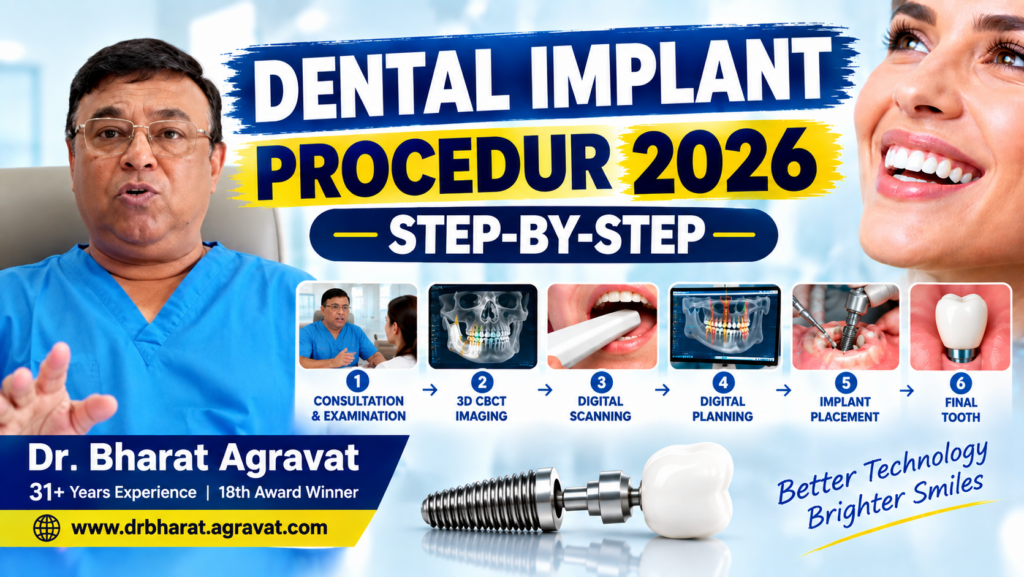
Dental Implant Procedure By Dr. Bharat Agravat — 31+ Years of Dental Experience | 18th Award Winner
AHMEDABAD, Gujarat, INDIA — September 17, 2026 — Dental implant treatment has evolved significantly with the integration of digital dentistry, advanced imaging, computer-assisted planning and improved clinical workflows. In 2026, patients considering a Dental Implant Procedure can experience a more digitally guided journey—from initial assessment and treatment planning through implant placement and final restoration.
Dr. Bharat Agravat, a dentist with 31+ years of dental experience and an 18th award winner, explains the modern Dental Implant Procedure step by step, helping patients understand what typically happens before, during and after implant treatment.
The process may also begin with an ATH AI-enabled free assessment developed by Dr. Kartavya Agravat, designed to provide an initial digital health and wellness assessment and help users understand whether they should seek professional evaluation. AI-based assessment is intended to support awareness and does not replace an examination or diagnosis by a qualified dental professional.

What Is a Dental Implant?
A dental implant is a replacement for the root portion of a missing tooth. It is typically placed into the jawbone and, after an appropriate healing period, connected to a restorative component such as an abutment and dental crown.
Unlike a conventional removable replacement, an implant-supported tooth is designed to function as part of a fixed tooth replacement system.
The suitability of implant treatment depends on individual factors including oral health, bone condition, general health, medications, smoking or tobacco use, gum health and the condition of neighboring teeth.
Dental Implant Procedure: Step-by-Step
Step 1 — Initial Dental Assessment
The first stage is a comprehensive clinical assessment.
The dentist reviews the patient’s dental history, examines the teeth and gums, evaluates the missing-tooth area and discusses the patient’s expectations.
Depending on the case, diagnostic imaging may be recommended.
For patients beginning their journey digitally, Dr. Kartavya Agravat’s ATH AI-enabled free assessment can provide an initial technology-assisted assessment experience. It should be viewed as an awareness and screening-support tool rather than a substitute for a dentist’s clinical examination.
Step 2 — Digital Imaging and Diagnosis
Modern implant dentistry can use digital radiography and three-dimensional imaging such as CBCT when clinically indicated.
These technologies can help the dental team evaluate:
- Jawbone dimensions
- Implant site anatomy
- Nearby anatomical structures
- Bone availability
- Position of adjacent teeth
- Treatment requirements
The dentist determines which diagnostic imaging is appropriate for each patient.
Step 3 — Digital Treatment Planning
Once the diagnostic information is available, the dental team develops an individualized treatment plan.
Digital planning can allow the dentist to evaluate implant position, restorative requirements and surgical considerations before treatment.
In selected cases, computer-assisted planning and surgical guides may be used to help transfer the planned implant position to the clinical procedure.
The goal is not simply to place an implant but to plan the complete tooth replacement—including the implant, abutment and final restoration.
Step 4 — Preparing the Mouth
Before implant placement, existing oral health problems may need to be addressed.
Depending on the patient, treatment may include management of gum disease, removal of a damaged tooth, treatment of infection or evaluation of bone volume.
Some patients may require additional procedures, such as bone augmentation, before or together with implant placement.
The exact sequence varies according to the individual case.
Step 5 — Dental Implant Placement
During the Dental Implant Procedure, the dentist creates an appropriate site in the jawbone and places the dental implant.
Local anesthesia is commonly used, while other forms of anesthesia or sedation may be considered depending on the procedure and patient.
Digital planning may assist the dentist in achieving the planned implant position, but the procedure remains a clinical treatment performed by a qualified dental professional.
Step 6 — Healing and Osseointegration
Following implant placement, the implant generally requires a period of healing.
During this stage, a process called osseointegration allows the implant to become integrated with the surrounding bone.
Healing time varies considerably between patients and depends on factors such as implant location, bone quality, surgical procedure and individual healing.
Patients must follow the treating dentist’s postoperative instructions during this period.
Step 7 — Abutment and Final Crown
Once the implant has adequately healed and the dentist determines that it is ready for restoration, an abutment may be connected.
The final dental crown is then designed and fitted to restore the appearance and function of the missing tooth.
Digital scanning and computer-aided laboratory workflows can be incorporated into the restorative process in appropriate cases.
Step 8 — Follow-Up and Maintenance
A Dental Implant Procedure does not end when the crown is placed.
Long-term maintenance is important.
Patients should maintain good oral hygiene, attend recommended dental check-ups and follow professional cleaning and maintenance advice.
Although implants are designed for long-term use, they can develop complications if oral hygiene is poor or if the surrounding tissues become affected by disease.

How Digital Dentistry Is Changing Implant Treatment
Digital dentistry has introduced new tools into the implant workflow.
Depending on the case and the dental practice, modern implant treatment may involve:
Digital consultation → AI-enabled preliminary assessment → Clinical examination → Digital imaging → 3D planning → Implant placement → Healing → Digital restoration → Follow-up
The technology can improve information sharing and treatment planning, but technology does not replace clinical judgment.
A dentist must interpret diagnostic information and determine whether implant treatment is appropriate.
The Role of ATH AI-Enabled Free Assessment
Dr. Kartavya Agravat’s ATH AI-enabled assessment adds a digital entry point for people who want to understand their health and wellness status before seeking professional care.
The concept combines technology-assisted assessment with healthcare awareness.
For dental patients, an AI-enabled assessment can help encourage individuals to recognize the importance of professional evaluation when they have missing teeth, dental discomfort, chewing difficulties or other oral-health concerns.
However, an AI assessment should not be considered a definitive diagnosis or a replacement for clinical examination, radiographic evaluation or treatment planning by a dentist.
Who May Be Considered for Dental Implants?
Dental implants may be considered for adults with one or more missing teeth when adequate conditions exist for implant treatment.
The dentist evaluates factors such as:
- Overall oral health
- Gum condition
- Available jawbone
- Existing dental infections
- Medical history
- Smoking and tobacco habits
- Oral hygiene
- Ability to maintain follow-up care
Not every patient is immediately suitable for implant placement. In some cases, preparatory treatment may be required first.
Why Patients Should Understand the Complete Procedure
Patients often focus on the implant itself, but successful treatment involves much more than implant placement.
The complete process can include diagnosis, treatment planning, surgical care, healing, restoration and long-term maintenance.
Understanding each stage can help patients have more informed discussions with their dental professional about treatment options, expected timelines, potential risks and costs.
Modern Dental Implants: Technology With Clinical Expertise
The 2026 Dental Implant Procedure reflects the growing integration of technology into dentistry.
AI-assisted tools, digital imaging, intraoral scanning, computer-assisted treatment planning and digital laboratory workflows can contribute to a more connected treatment process.
At the same time, the fundamentals remain unchanged: accurate diagnosis, appropriate case selection, sound clinical decision-making, careful surgical technique and long-term maintenance.
Dr. Bharat Agravat emphasizes that patients should consider dental implants only after a qualified dental professional has evaluated their individual oral and general health circumstances.
About Dr. Bharat Agravat

Dr. Bharat Agravat is a dentist with 31+ years of dental experience and an 18th award winner, associated with modern digital dental care and patient education.
His approach combines established dental principles with contemporary digital technologies to help patients better understand procedures such as dental implants. visit :
About Dr. Kartavya Agravat and ATH

Dr. Kartavya Agravat, Dental Surgeon and AI Healthcare Expert, is associated with ATH—an AI-enabled health and wellness assessment platform designed to provide users with an accessible digital assessment experience.
ATH is intended to support health awareness and does not replace professional medical or dental diagnosis. learn more https://dr.agravat.com/
Patient Information
Anyone considering a Dental Implant Procedure should consult a qualified dentist for an individualized examination and treatment plan.
The number of appointments, need for bone augmentation, implant type, healing period, restoration approach and overall treatment timeline can vary from patient to patient.
Dental implant treatment is not a one-size-fits-all procedure.
The most appropriate approach depends on the patient’s clinical findings and the professional judgment of the treating dental team.
Media Contact
Dr. Bharat Agravat
Dr. Agravat Dental Clinic & Implant Wellness Center
Ahmedabad, Gujarat, India
Website: www.drbharat.agravat.com
FAQs “Dental Implant Procedure
1. What is a Dental Implant Procedure?
A Dental Implant Procedure replaces the root of a missing tooth with a dental implant, which can later support an abutment and dental crown. The treatment usually involves assessment, digital imaging, treatment planning, implant placement, healing and final restoration.
2. How long does a Dental Implant Procedure take?
The timeline varies depending on the patient’s oral health, bone condition and whether additional procedures are required. Some cases can be completed relatively quickly, while others require several months for healing and implant integration before the final crown is placed.
3. Are Digital Dental Implants better than traditional implants?
Digital dentistry can assist with imaging, treatment planning and guided implant placement. However, the suitability and expected outcome of an implant depend on the individual patient’s clinical condition and the dentist’s treatment plan. Digital technology supports the dentist; it does not replace clinical judgment.
4. Can ATH AI provide a free dental assessment?
ATH by Dr. Kartavya Agravat provides an AI-enabled free assessment designed to support initial health and wellness awareness. It can be a useful starting point for understanding whether professional evaluation may be appropriate, but it does not replace a clinical dental examination, diagnosis or X-ray/CBCT assessment by a qualified dentist.
5. Who is a suitable candidate for dental implants?
Adults with missing teeth may be candidates for dental implants when their oral and general health, gum condition and available bone support implant treatment. A qualified dentist must evaluate each case individually and may recommend preparatory treatment before implant placement.
